


.png)

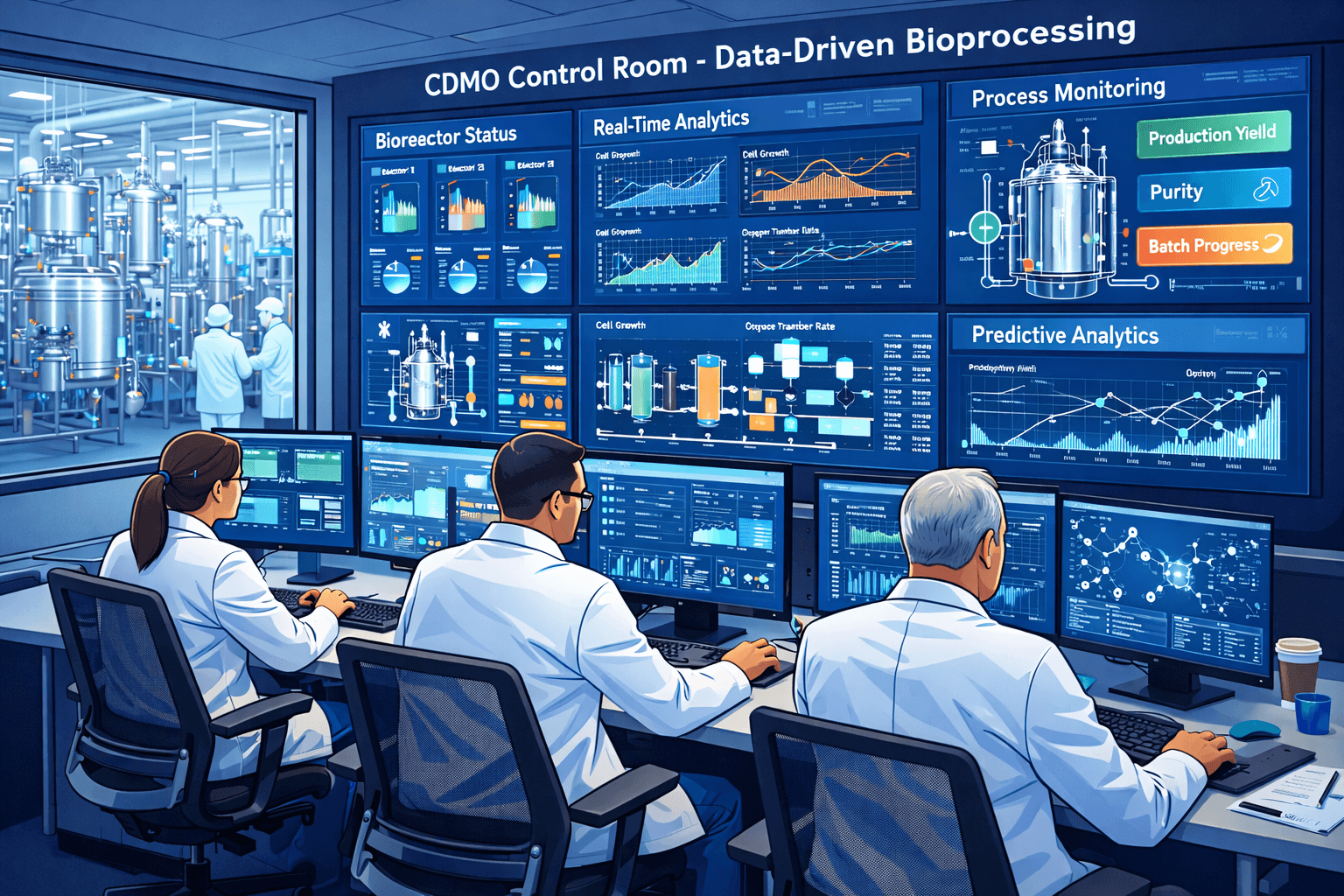
Bioprocessing has always sat at the intersection of science, engineering, and manufacturing. While the underlying science has advanced rapidly, much of the bioprocessing industry still operates with tools, workflows, and economic models that were designed decades ago. Meanwhile, advancements in other industries, electronics being a prime example, and economic pressures have changed expectations around timelines, cost, and reproducibility.
Those shifting expectations are forcing the industry to evolve, and creating opportunities for companies with modern processes to turn this shift into a competitive advantage.
An industry still running on legacy systems
In many ways, bioprocessing today looks remarkably similar to how it looked a generation ago. Many teams are still working with processes their parents or even grandparents used. While individual instruments may be highly automated, the broader biomanufacturing workflow remains largely manual and manually monitored.
The infrastructure itself reflects this reality. Roughly 85% of large-capacity vessels in use today are around 40 years old. Process development is still heavily manual, with critical knowledge living in people’s heads rather than in systems. Too often, teams are forced to start from scratch instead of building on prior learnings and compounding progress over time.
What is required is a significant shift, first of all, in mindset, but then also in the technology itself and what it can do for biomanufacturing.
Making learnings cumulative
The most important advantage of implementing software into bioprocessing, is making learning cumulative and actionable.
When process data is captured, contextualized, and you can see it all in one place, you can build on top of those learnings. Instead of relying on individual experience or scattered spreadsheets, organizations begin to develop institutional knowledge that accelerates every subsequent decision.
This is precisely why YDLabs, one of the most innovative CDMOs, implemented BioRaptor as their bioprocessing data platform. As Ariel Blumovich, founder and CEO of YDLabs, explains, “It’s the difference between knowledge living in someone’s head and knowledge accumulated in software.”
That shift, from tacit knowledge to shared, compounding insight, changes how teams work and what they can realistically achieve.
Rethinking incentives and pricing structures
Historically, CDMOs have priced their services by runs, hours, or resources consumed. On the surface, this seems reasonable. In practice, it creates deeply misaligned incentives. If a process requires more runs, it costs more. If a run fails, the client absorbs the risk. Efficiency and learning are rarely rewarded.
“That misalignment was always mind-boggling to me,” says Ori Zakin, CEO of BioRaptor. “Why would I incentivize a CDMO to give me better yield if they charge by hour or by run? If the run fails, it’s the customer’s problem.”
YDLabs is actively moving away from run-based pricing toward outcome-based commitments. Instead of estimating how many experiments might be required and billing accordingly, they price projects from point A to point B with a fixed cost and timeline. “You know exactly what you’re paying, and exactly how long it takes,” Ariel says. “That brings certainty for the client.”
Software as the enabler of predictability and scale
That level certainty is only possible because bioprocessing data software reduces variability and compresses learning cycles. Where incremental improvements once came slowly, software-run processes make those gains compound far more rapidly.
“Before BioRaptor, our improvements lived in people’s heads. With BioRaptor, that knowledge compounds. What used to be 5% gains run-to-run can turn into 20%, 30%, even 50% improvements, because learning is captured, shared, and built on,” notes Ariel.
For CDMOs, this becomes a strategic advantage. Faster convergence means the same teams can serve more clients without compromising quality. Predictability allows them to commit to outcomes with confidence. For biotechs, it means fewer wasted batches, clearer timelines, and decisions grounded in evidence rather than hope.
The result is trust and confidence in the process, a scarce commodity in an industry where uncertainty has long been accepted as inevitable.
Expanding what's possible in bioprocessing
Importantly, this shift is pushing the boundaries of what’s possible in bioprocessing. Software enables better outcomes because teams can finally see all their data in one place, patterns across runs, connect context to results, and act on insights in near real time.
It also reframes what innovation means in this industry. For Ariel, being an innovative CDMO means delivering better results for their clients consistently and efficiently.
Those benefits extend far beyond individual organizations. Faster development cycles bring products to market sooner. More reproducible processes reduce waste and cost. Predictable timelines make collaboration less adversarial and more strategic. In that sense, software adoption strengthens the entire ecosystem.
Bioprocessing is at an inflection point. Teams that continue to rely on fragmented tools and intuition alone will struggle to keep pace with those who compound learning across every run.
Biotechs and biomanufacturers that see software as a tool helping reshape how they work, how they structure partnerships, and how they deliver value, are quietly pulling ahead.
And increasingly, that difference is becoming a competitive advantage the rest of the industry can’t ignore.
If you would like to learn how BioRaptor can improve your bioprocess, schedule a demo and we'll gladly walk you through it.

