


.png)

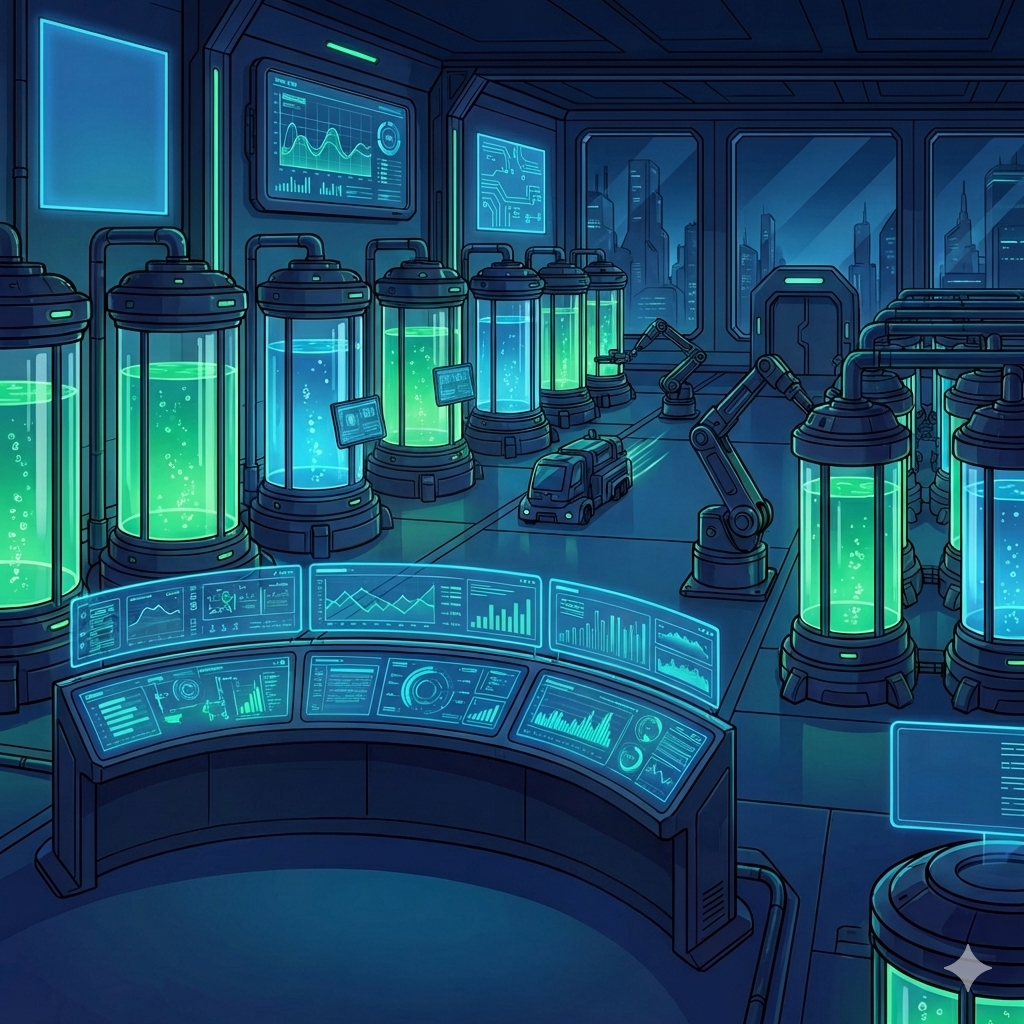
Other industries have been moving rapidly toward fully automated manufacturing facilities.
Is it an option for biotech manufacturers, and what would it take to fully embrace it?
Definition: by “dark factories” we mean mostly automated, often AI-driven facilities where most tasks are automated, they run day and night with very minimal human oversight and often are praised for quality, consistency and efficiency.
Electronics, automotive, and logistics have long adopted “dark factory” principles of automation, moving toward continuous production with minimal human intervention, guaranteeing consistency and performance.
Consumer electronics company, Xiaomi, now produces one smartphone per second thanks to its fully automated, AI-driven facility that runs every second of the day without human participation.
Now, CDMOs are beginning to ask the same question - can biotechnology adopt this model, and what would it mean for the people, processes, and clients?
What does “dark factory” look like for CDMOs
Today, most CDMOs operate in a way that reflects the nature of biology itself: hands-on, variable, and heavily dependent on the people running the process. Even with advanced equipment and good automation on individual instruments, much of the biomanufacturing workflow is still manually executed and manually monitored.
Runs happen around the clock, which means staffing happens around the clock. Night shifts, handoffs, and operator notes stitched together across multiple people. And even when everyone is exceptionally careful, human variation still slips in.
Two technicians will enter data differently. Three will interpret an SOP three slightly different ways. Shift changes show up directly in the data from the way a batch name is typed to timing of samples to the interpretation of “close enough.”
A “dark factory” in biotech means removing the need for constant oversight, introducing automation and reducing possibility of human error. It means building a system where processes run predictably, data is captured uniformly, and intervention only happens when it truly matters.
This is already happening with some CDMOs. They used to run 24/7 shifts. Today, there is no night shift. Their reactors run autonomously overnight while the system monitors everything remotely. If something requires attention, the right person gets an alert. Many issues can be solved instantly, without stepping foot into the facility.
During the day, teams still do all the physical, biological, and operational work that can’t be automated like equipment changes, maintenance, feed additions, but they do it with far less time spent babysitting processes or reconciling messy data.
Why quality, not cost, should lead the discussion
The temptation is to think automation is about reducing labor costs. But for CDMOs, the biggest value lies elsewhere - in process consistency, and quality.
Manual operations are inherently variable. Every technician has their own timing, formatting, and intuition. Each shift hands over to another with small discrepancies that compound into bigger yield or quality differences.
Automation removes that.
It ensures that a run behaves identically at 2 p.m. and 2 a.m., that data formats don’t vary, and that deviations are detected before they affect results.
When you remove human error, you elevate reliability and quality.That’s what customers actually buy when they choose a CDMO: trust that the process will perform the same way every time. (Something very few CDMOs can guarantee today).
What dark factories offer CDMOs and their customers
Dark factories at their core will require an integrated operating system designed to manage and monitor all process parameters, minimizing variability to ensure a robust consistent process.
Such a system enables true repeatable processes, reduces operational costs, enhances transparency, and drives better decision-making.
For CDMOs, dark factories bring cost savings, fewer unplanned interventions, higher reproducibility, and the ability to run more processes in parallel without expanding headcount.
Customers working with CDMOs that run dark factories means real-time visibility into outsourced production, less variability, fewer repeats, and faster tech transfer.
For teams, it means more meaningful work. Instead of spending nights monitoring runs, scientists focus on experiment design, troubleshooting, and innovation.
In this model, automation removes manual repetitive tasks as well as possibility of human error and empowers people to do meaningful work.
The factory becomes self-sufficient at execution, and human expertise moves higher up the value chain- toward insight, optimization, and decision-making.
Toward lights-off, quality-on biomanufacturing
The phrase “dark factory” may sound negative but in life sciences it actually brings the opposite - more clarity and more confidence.
As CDMOs consider what a “dark factory” could look like in biotech, the real shift is less about full automation and more about operational maturity. Reducing manual oversight, standardizing execution, and capturing data consistently create an environment where biology can run predictably, even when people aren’t constantly present. The result is higher quality, fewer surprises, and clearer collaboration between CDMOs and their customers. Dark factories, in this sense, are not an endpoint but a direction: one where automation supports reliability, data replaces guesswork, and human expertise is applied where it adds the most value.
See how CDMOs are already using BioRaptor to monitor processes remotely, standardize runs, and maintain 24/7 consistency.
👉 Visit our CDMO use case page to learn more.

